|
There are four factors that determine the value of a diamond, collectively known as the "Four C's". The combination of the “Four Cs” determines each diamond's value.
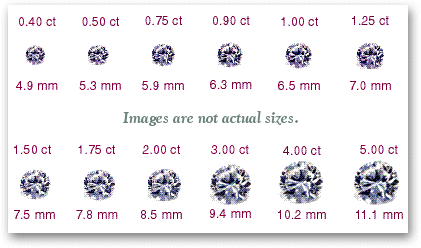
Carat — This word for the measurement of a diamond's weight is derived from the carob seeds that were used to balance scales in ancient times. Today’s metric carat is equal to 200 milligrams, or one-fifth of a gram, and there are approximately 142 carats to an ounce. Carats are further divided into points. There are 100 points in a carat. A half-carat diamond may be referred to as a 50-point stone . Because large diamonds are rare, they generally have a greater value per carat.
Color — Diamonds come in every color of the spectrum, but the most popular gems are colorless. Truly colorless, pure white diamonds are extremely rare and therefore the most costly. Stones are graded by the Gemological Institute of America (GIA) and most other international laboratories according to color and given designations based on how far they deviate from the purest white. Colorless stones are graded D, E, or F. All three grades are considered colorless but with slightly decreasing transparency. Color grading continues down through the alphabet, with each letter designating a slight darker or warmer tint. The best way to see the true color of a diamond is by looking at it against a white surface. Although the great majority of diamonds come in shades of white, yellow, and brown, the gems also come in a spectrum of majestic colors, from red and canary yellow to blue, green, and purple. These colorful diamonds, known as fancies, are valued for their depth of color, just as white diamonds are valued for their lack of color. Diamond color grades are determined by professionals under ideal circumstances, a situation seldom duplicated outside of a laboratory. Choose a diamond based on its appeal to you, rather than on a technical color scale.
| GIA Color Grade |
Description |
| D, E, F |
Colorless |
| G, H, I, J |
Near colorless |
| K, L, M |
Faint yellow or brown |
| N to Z |
Very light to light yellow or brown |
Clarity — A diamond’s clarity is affected by any external and internal characteristics created by nature when the diamond was formed or as a result of the cutting process. Characteristics such as internal spots or lines are called inclusions. Although these marks make each stone unique, the fewer the inclusions, the more valuable the stone. Inclusions can sometimes interfere with the passage of light through the stone, diminishing the sparkle and value of the diamond. According to the quality analysis system of the Gemological Institute of America, clarity is graded on a scale ranging from Flawless (Fl) to Imperfect (I). Only a tiny percentage of diamonds ever achieve a grade of Flawless.
It is important to remember that both color and clarity are ranges. Think of a color or clarity grade as your age. If you’re 34 years old, your 34th birthday may have been yesterday, or your 35th birthday may be next month. But when someone asks your age, you simply tell them you’re 34. It works the same way with color and clarity grading. For example, a diamond with a G color grade could, in fact, be very close to an F or to an H. The same principle applies to clarity grading.
Cut —Each diamond is cut to very exacting standards. The most common cut, the round brilliant, has 58 facets, or small, flat, polished planes designed to yield the maximum amount of light to be reflected back to the viewer. 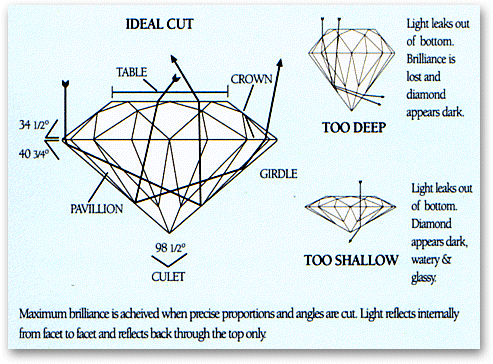 This reflection, known as brilliance, is an extremely important factor in evaluating the quality of a diamond’s cut. A poorly cut diamond will actually lose light and appear dull. The widest circumference of a diamond is known as the girdle. Above the girdle of a brilliant cut diamond are 32 facets plus the table, the largest and topmost facet. Below the girdle are 24 facets plus the culet, or point. Cut is also used to describe the shape of a diamond. In addition to the round brilliant, other popular cuts include emerald, marquis, pear, oval, and square. This reflection, known as brilliance, is an extremely important factor in evaluating the quality of a diamond’s cut. A poorly cut diamond will actually lose light and appear dull. The widest circumference of a diamond is known as the girdle. Above the girdle of a brilliant cut diamond are 32 facets plus the table, the largest and topmost facet. Below the girdle are 24 facets plus the culet, or point. Cut is also used to describe the shape of a diamond. In addition to the round brilliant, other popular cuts include emerald, marquis, pear, oval, and square.
 Click here to see examples of different stone cuts. Click here to see examples of different stone cuts.
A diamond’s cut impacts four aspects of the stone’s optical and physical properties:
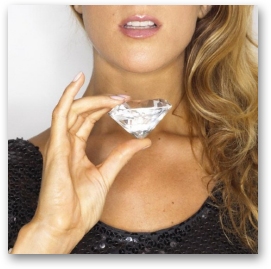 Luster — The quality and amount of light that is reflected off just the surface of the diamond. Luster is directly related to the hardness of the stone and the quality of its polish. Luster — The quality and amount of light that is reflected off just the surface of the diamond. Luster is directly related to the hardness of the stone and the quality of its polish.
Brilliance — The amount of white light that is returned to the eye from both internal and external surfaces. Brilliance is determined by the quality of the diamond’s polish and the number and size of inclusions inside the gem.
Dispersion — The display of spectral or rainbow colors seem coming from the inside of a diamond. Often referred to as “fire,” dispersion is directly related to how well the stone is proportioned.
Scintillation — A diamond will show scintillation, or “sparkle,” when movement is involved. The viewer, the light source, or the diamond itself must be in motion for scintillation to happen.
The most important part of choosing a diamond is to choose one that appeals to you personally. While it is important to understand the technical aspects of diamonds, it’s most important to fall in love with your diamond.
|